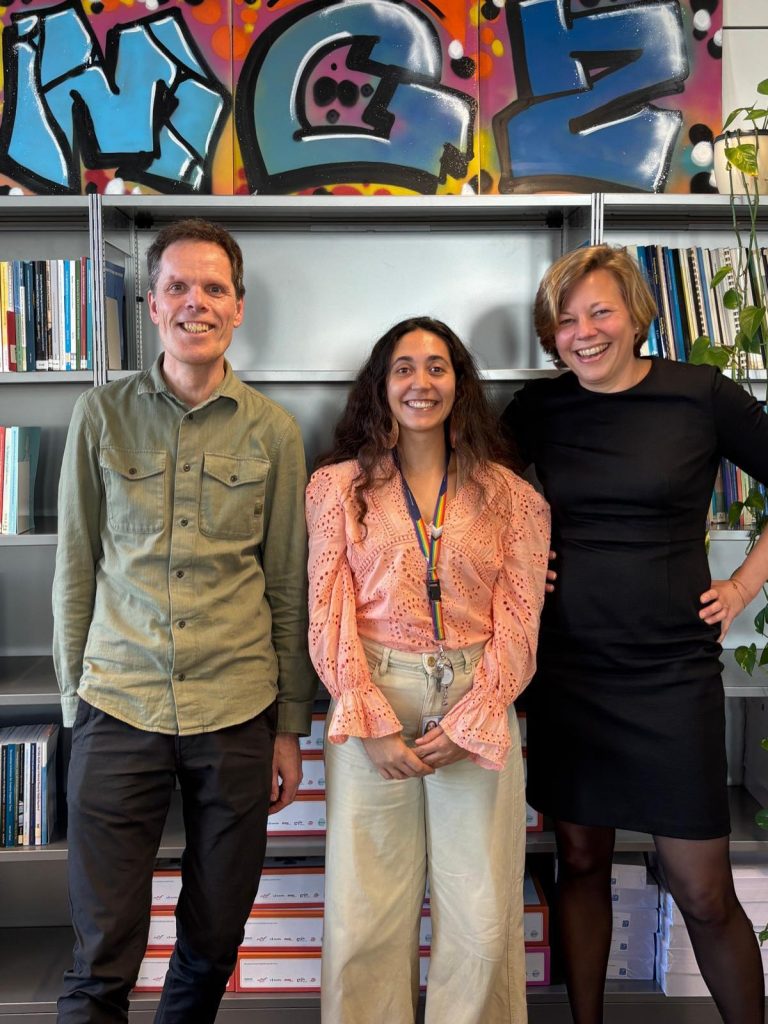
In this news Cláudia Cruz Oliveira, a PhD candidate at the Department of Public Health at Erasmus University Medical Center is presenting her research work.
“It has been a great pleasure to contribute to the meaningful task of advancing prostate cancer decision‑making through the development of prognostic tools. I am genuinely grateful for the opportunity these projects have given me to strengthen my methodological skills, deepen my critical thinking, and grow as a researcher. Working within an interdisciplinary environment has broadened my perspective and enriched the way I approach scientific questions. I am also fortunate to collaborate with a team whose enthusiasm and commitment are truly inspiring, creating a motivating environment that continually energizes my work.”
Prof. Hester Lingsma is the head of the Department of Public Health at Erasmus University Medical Center Public Health Department, and Dr. David van Klaveren is an associate professor at the same department and the lead of the prediction modelling work package in 4D PICTURE project. Together with Caludia they form a team driven by a shared commitment to making a meaningful impact. We work in close collaboration with prostate cancer experts across multiple disciplines, whose guidance helps us focus our efforts on the areas of greatest clinical need.
Does diagnosing prostate cancer lead to meaningful life‑year gains that justify biopsy?
They are developing a model that informs patients on potential life years gained from curative treatment, if prostate cancer is diagnosed. This tool is designed to complement information on the risk of having prostate cancer upon deciding whether to perform a biopsy. Using relative survival methods, they have estimated prostate cancer hazard and applied the PIVOT trial’s treatment effect to derive life‑years gained. The model is based on Dutch data but they aim to externally validate it in an independent cohort.
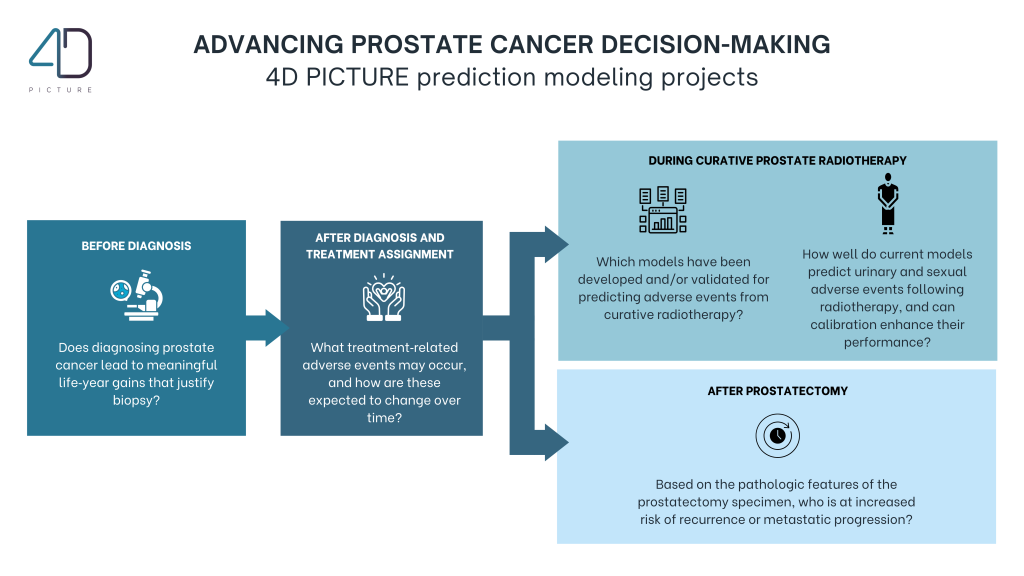
What treatment‑related adverse events may occur, and how are these expected to change over time?
They will externally validate, and if necessary, update, a previously developed web-based tool that predicts personalized sexual, urinary, bowel, and hormonal function outcomes after different prostate cancer treatments. If the tool demonstrates good discrimination and calibration, it could serve as a valuable resource to support patients in understanding their expected quality of life after treatment.
Which models have been developed and/or validated for predicting adverse events from curative radiotherapy?
They have systematically reviewed studies published between 2004 and 2024 to identify the best performing and adequately developed prediction models in the field of curative prostate cancer radiotherapy. Their findings highlight a need for more external validation studies to advance predictions of adverse events in this field.
How well do current models predict urinary and sexual adverse events following radiotherapy, and can calibration enhance their performance?
They have externally validated models predicting urinary incontinence and sexual function in patients undergoing radiotherapy. Because the models showed miscalibration, they intend to recalibrate them to improve their accuracy. These models may support clinical decision‑making during treatment planning and be used to inform patients about their individual risk of adverse events, potentially enhancing preparedness and supporting better coping throughout their treatment journey.
Based on pathological features, who is at increased risk of recurrence or metastatic progression after prostatectomy?
Newly developed pathological score includes the percentage of Gleason pattern 4 and 5, and the presence of invasive cribriform and intraductal carcinoma at prostatectomy. The score predicts biochemical recurrence-free survival and metastasis-free survival. Interpretation for clinicians and patients is easy and may both optimize and simplify inclusion of pathological variables in clinical nomograms.