
When you’re diagnosed with cancer, it can feel as though control of your life has suddenly been handed to somebody else.
There are scans, appointments, operations, drugs, blood tests and treatment plans. There are consultants, surgeons, oncologists and specialist nurses who understand the medicine far better than you ever will.
But there is one person in that room who understands something they don’t:
You understand you.
Over the years, one of the most important things I have learned through my experiences with melanoma is the value of shared decision making.
It means that decisions about my treatment aren’t simply made for me. They are made with me.
My journey has involved some enormous decisions
I was first diagnosed with melanoma in 2013. Since then, cancer has returned several times, taking me from early-stage disease to Stage III and eventually Stage IV melanoma.
I’ve undergone major surgery, including lymph-node clearance and the removal of most of my pancreas and my spleen. I’ve had immunotherapy, years of scans and, more recently, faced melanoma returning in my bowel.
Each stage has brought different conversations and different decisions
One of those decisions was just after my lymph nodes were removed in 2017. My oncologist was confident that all the cancer had been caught and that we could just sit back and “wait and watch”. I was not happy with that. There were few reasons for me feeling scared:
- The cancer was now inside my body and no amount of checking for lumps was going to help me find it.
- The cancer had already shown that it can be very “clever” in finding ways to kill me.
- Scans were the only real scientific way to see what’s going on. I always look for evidence, it’s just the way I think.
I pushed my Oncology Team for regular scans to be extra safe. Eventually they agreed despite them telling me “scans are not good for you”.
Four years later, in 2021, the scan showed that the cancer had returned and was happily attacking my pancreas. I had no symptoms. I was perfectly healthy running, walking and just enjoying my life in an ordinary sort of way.
Balancing treatment benefits and risks
When my melanoma returned and I started ipilimumab and nivolumab — IPI-NIVO — I knew this was powerful treatment. I also knew it carried the risk of significant immune-related side effects.
Unfortunately, I experienced them.
After treatment I developed severe immune-related colitis and subsequently adrenal insufficiency. Treatment had to be reconsidered and conversations with my medical team became incredibly important.
Do we continue?
Do we stop?
Do we change treatment?
What are the risks of another dose?
What happens if we don’t give it?
These aren’t simply medical questions – they are life questions.
The scan that changed the conversation
Then came one of those extraordinary appointments that anyone living with Stage IV cancer hopes for.
After only a small number of treatments, my scan showed no measurable disease. The deposits in my small bowel had resolved.
Fantastic news.
But even good news can create another decision.
Having responded so well, how aggressively should we continue treatment when my immune system had already demonstrated just how powerfully it could react?
The conversation moved towards continuing with single-agent nivolumab rather than simply pushing ahead regardless of what my body had been through.
That, to me, demonstrates what shared decision making should be.
It isn’t the patient telling the doctor what treatment they want.
And it isn’t the doctor telling the patient what is going to happen.
It is a conversation.
What does the evidence tell us?
What are the benefits?
What are the risks?
What alternatives are available?
And, importantly, what matters to me?
Quality of life matters too
Cancer treatment isn’t just about keeping somebody alive.
It is about helping them live.
That distinction has become increasingly important to me.
I want to travel. I want to walk in the mountains. I want to take photographs, look through my telescopes, spend time with the people I love and continue raising awareness of melanoma.
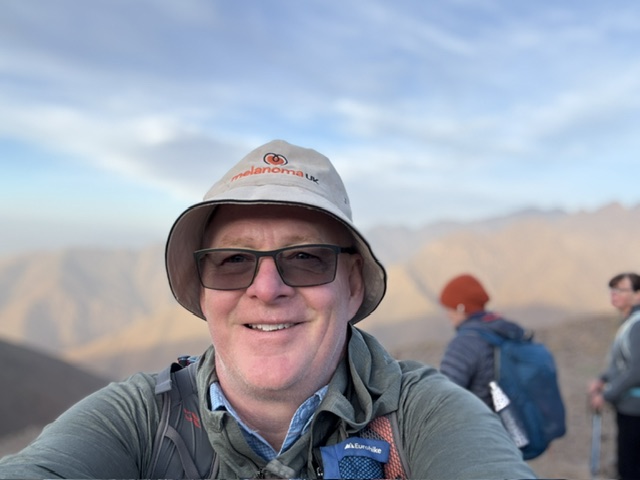
I’ve climbed Kilimanjaro twice. I’ve trekked through the High Atlas Mountains. I’ve travelled, fundraised, spoken about melanoma and tried to squeeze as much living as possible into the spaces between scans and hospital appointments.
So, when treatment decisions are discussed, quality of life matters to me.
A treatment might look like the obvious choice on a piece of paper, but if the consequences dramatically affect someone’s ability to live the life that matters to them, that deserves to be part of the conversation.
Shared decision making recognizes that.
Learning to ask questions
I’ve also learned to ask questions and to challenge my oncology team/ nurses based on my own understanding and my own feelings including anxiety.
Years ago, I probably wouldn’t have questioned a consultant very much.
Cancer changed that.
Today I want to understand:
Why are we doing this?
What does the scan actually show?
What happens if this treatment doesn’t work?
What are the alternatives?
What side effects should I watch for?
What would you recommend if you were sitting where I am?
Asking questions isn’t challenging your medical team – its’s becoming part of your own medical team.
I’ve been fortunate to have clinicians who have listened to me, explained and involved me in decisions. Initially they are a little surprised about the questions but they then begin to understand why it’s important to me as a patient. More importantly, as a “person”. My experiences with the Oncology Team are now so much more enjoyable and valuable in that I now understand so much more about the decisions that they are making in conjunction with my own thoughts and feelings. Their expertise is invaluable, but so is the knowledge I have gained from living inside this body through more than a decade of melanoma.
The patient brings expertise too
That is perhaps the biggest lesson I’ve learned.
Doctors bring years of medical training, clinical experience and scientific evidence to the table.
Patients bring something different.
We bring our experiences, fears, priorities, families, ambitions and understanding of what we are prepared to go through.
Neither should exist in isolation.
The best decisions happen when those two forms of knowledge meet.
There have been moments during my cancer experiences when there hasn’t been a perfect answer – only a choice between different risks.
In those moments, being listened to matters enormously.
Because ultimately it is my body, my treatment, my quality of life……
My future
I don’t want to make those decisions alone — I want the knowledge and experience of the brilliant people treating me.
But equally, I don’t want those decisions made without me.
I want us to make them together.
That is what shared decision-making means to me.
Cancer may have taken away a great deal of certainty over the years, but being involved in decisions about my treatment gives me something incredibly important back:
a voice – MY voice
And every patient deserves to have one.
One Life … LOVE IT … LIVE IT.